Subterranean termites nest underground and rely on constant moisture, making properties near the Maumee River and Ottawa River particularly susceptible during the April through June swarming season. Older Victorian…
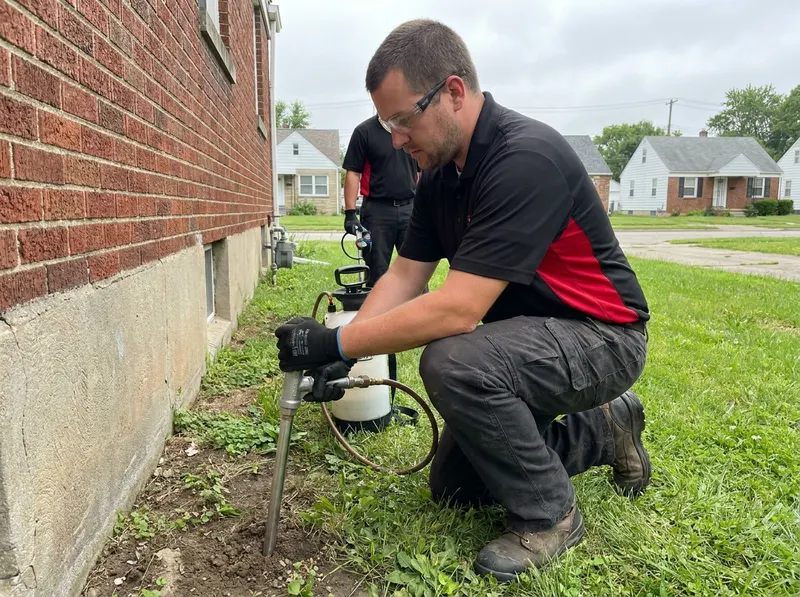
Subterranean termites nest underground and rely on constant moisture, making properties near the Maumee River and Ottawa River particularly susceptible during the April through June swarming season. Older Victorian foundations throughout the Old West End and brick-and-timber basements in West Toledo frequently display mud tubes along stone sills and structural rim joists. In lakefront areas like Point Place, sandy-loam subsoils shift moisture quickly, driving worker termites upward into subflooring. Properties in Five Points, Reynolds Corners, and the South End built over unvented crawl spaces often show concealed sill plate damage before outward signs appear. A professional subterranean barrier halts this progress by breaking the critical connection between the subterranean soil colony and the timber framing of the house.
Treatment selection depends on architectural construction. Monolithic concrete slabs in modern Ottawa or Beverly ranch homes require precision interior slab injection along expansion joints and plumbing penetrations. In contrast, historic homes in Birmingham with stone foundations require continuous perimeter trenching, applying non-repellent liquid termiticides at a standard depth of 6 inches down to the top of the footing. A full perimeter trenching installation requires significant exterior preparation, while an interior bait-station network leaves exterior landscaping intact but demands ongoing monitoring to confirm colony elimination.
Treatment involves a predictable sequence to safeguard structural integrity. First, technicians sound structural beams and map subterranean shelter tubes across the basement and exterior perimeter. Second, a 6-inch by 6-inch soil trench is excavated along exterior foundation walls, applying 4 gallons of non-repellent liquid termiticide per 10 linear feet. Third, attached garage slabs, front porches, and patios undergo vertical drilling at 12-inch intervals to inject termiticide directly into underlying soil layers, followed by concrete patch seals. Finally, structural members receive moisture readings to confirm that active soil moisture channels are broken. Indoor treatments do not require mandatory long-term monthly fee contracts, and non-repellent treatments bond directly to the soil matrix once dried, maintaining structural defense without airborne drift around household pets.
Every job gets a firm, written price after a free on-site visit.
Tell us about your subterranean termite treatment job in Toledo and we'll send a clear, written quote, usually the same day.
 Jorvian Pest Management