Health inspections by municipal authorities evaluate both visible activity and underlying structural vulnerabilities. Establishments near food-dense commercial areas, such as Secor Road in West Toledo, the Broadway…
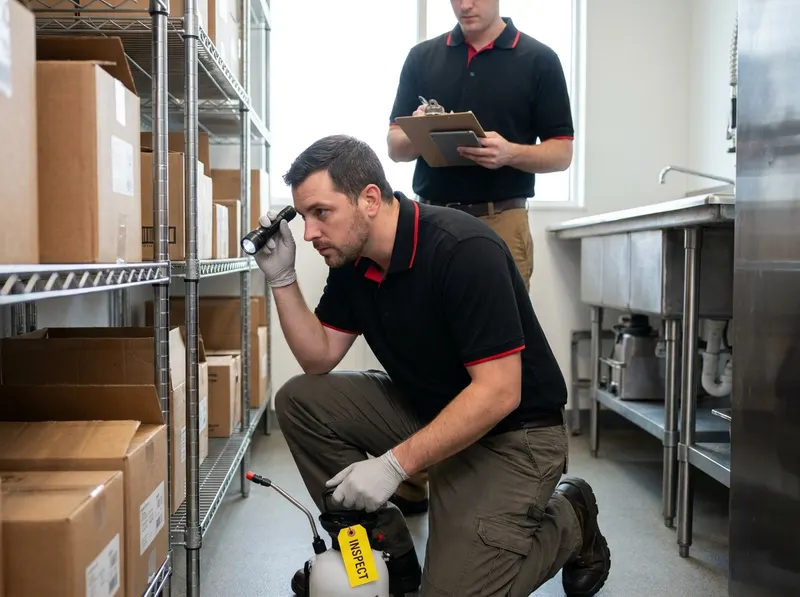
Health inspections by municipal authorities evaluate both visible activity and underlying structural vulnerabilities. Establishments near food-dense commercial areas, such as Secor Road in West Toledo, the Broadway corridor in the South End, and waterfront operations in Point Place, face localized vector risks. Older brick and masonry constructions, common across Five Points, Birmingham, and the Old West End, frequently present foundation expansion gaps, worn door sweeps, and unsealed utility conduits. Toledo code enforcement requires verified corrective actions rather than cosmetic fixes, meaning retail aerosol sprays fail to satisfy inspector remediation orders. Targeted barrier defense concentrates active materials inside wall voids, behind stainless steel prep lines, and around floor drains, completely isolating treatments away from open food prep surfaces and maintaining indoor air safety.
Decision fit separates audit-readiness treatments from standard extermination. Standard extermination often relies on broad broadcast treatments that disperse pests into adjoining storage areas; audit-compliant protocols utilize species-specific bait matrixes, mechanical monitoring stations, and non-volatile perimeter barriers. Facilities operating near moisture-heavy sections along the Maumee River or near Ottawa Park encounter seasonal rodent shifts each autumn as outdoor temperatures drop below 45 degrees Fahrenheit. In such environments, mechanical exclusion, like copper mesh packed around beverage-line penetrations and tight-fitting door gaskets, provides structural longevity that treatments alone cannot match.
Operational execution follows a 4-step sequence: 1. Complete mechanical audit of food storage, dishwashing bays, and dumpster pads. 2. Placement of tamper-resistant monitoring traps mapped to a physical facility floor plan. 3. Application of precision gel baits and insect growth regulators strictly confined to utility voids and sub-counter framing. 4. Generation of a formal service logbook containing chemical application records, target pest maps, and sanitary action items required for city health inspector review.
Every job gets a firm, written price after a free on-site visit.
Tell us about your commercial health-inspection pest management job in Toledo and we'll send a clear, written quote, usually the same day.
 Jorvian Pest Management